
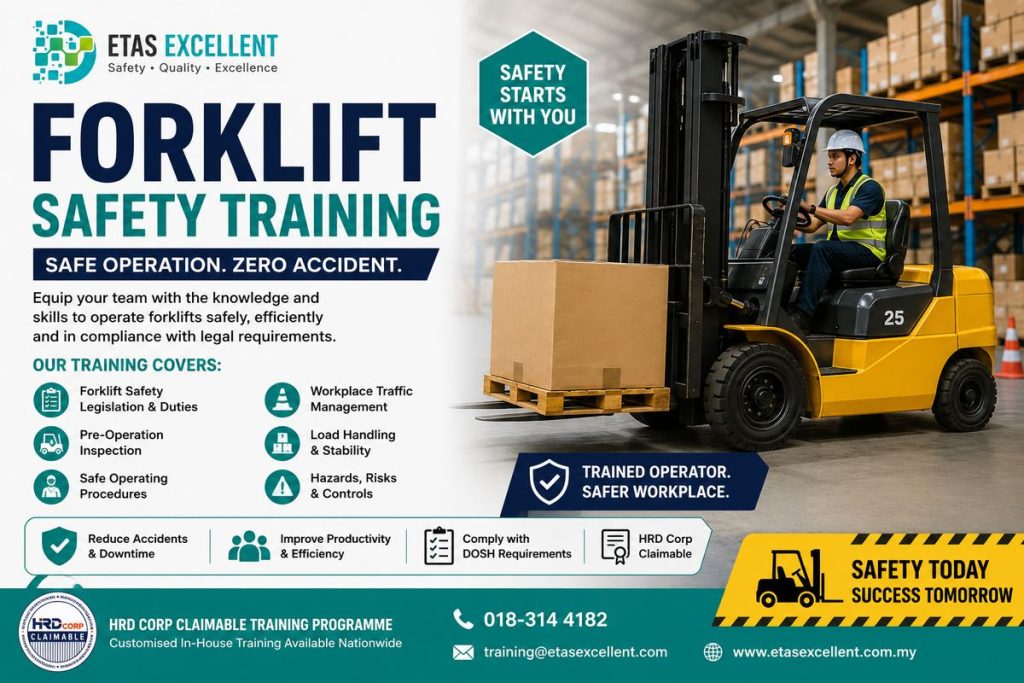
Forklift Safety Training at Your Workplace
Practical operator training for factories, warehouses and logistics facilities, using your equipment and working environment.
Build safer habits around pre-use checks, forklift stability, load handling and pedestrian traffic. Training can be tailored to your site and forklift type, including reach trucks where appropriate.
Call / WhatsApp: 018-314 4182 · *Subject to employer eligibility and HRD Corp approval.
Prevent common forklift incidents
Collisions with pedestrians, overturning, falling loads, poor visibility and missed equipment defects can lead to serious harm. Operators need suitable training alongside site traffic controls, supervision and maintenance.
Read the original Forklift Safety Guide for more practical guidance.
Separate traffic
Address walkways, blind corners, reversing, intersections, communication and exclusion zones.
Check before use
Inspect forks, tyres, brakes, steering, warning devices, seat belt, leaks and the capacity plate. Report defects promptly.
Keep loads stable
Understand rated capacity, load centre, safe fork positioning, travelling height, stacking and slopes.
Training that reflects your daily operations
Use your forklift, warehouse layout, racking, loading bays, pedestrian routes and actual work tasks to make practical exercises relevant. The client normally provides a safe forklift, suitable training area and loads or pallets.
Who should attend
- New and existing forklift operators
- Operators due for refresher training
- Warehouse, logistics, production and material handling staff
- Supervisors, team leaders and OSH personnel
Typical workplace settings
- Factories and production areas
- Warehouses and distribution centres
- Logistics and storage facilities
- Construction and other industrial workplaces
What participants learn
A focused mix of classroom learning, supervised practice and assessment. Practical activities depend on the site, equipment and safe space available.
1. Safety fundamentals
Operator responsibilities, common incidents, unsafe behaviour, workplace traffic risks and forklift components and controls.
2. Stability and inspections
Stability triangle, centre of gravity, load centre, capacity, turns and slopes; pre-use inspection and defect reporting.
3. Safe operation
Starting, seat belts, travel speed, turning, reversing, visibility, intersections, parking and shutdown.
4. Handling loads
Assessing, lifting, carrying, stacking and de-stacking loads while observing capacity and load stability.
5. People and traffic
Pedestrian separation, blind spots, warning signs, horns, safe distance and clear communication.
6. Practice and assessment
Supervised manoeuvring, pre-use checks, load handling and parking, followed by theory and practical assessment.
A certificate records training and assessment
Participants who meet the assessment criteria may receive a Certificate of Successful Completion. This is not a government-issued forklift driving licence or a DOSH statutory competency certificate. Employers should maintain their own operator authorisation, risk assessment, safe work procedures and supervision.
Available across Malaysia
Arrange in-house training at your premises, subject to scheduling and site requirements. Typical locations include:
- Kuala Lumpur
- Selangor: Shah Alam, Klang, Petaling Jaya, Subang Jaya, Puchong, Seri Kembangan, Bangi, Kajang
- Negeri Sembilan: Seremban, Nilai
- Melaka: Ayer Keroh, Batu Berendam, Alor Gajah, Jasin
- Johor: Johor Bahru, Pasir Gudang, Senai, Kulai, Batu Pahat
- Penang: Bayan Lepas, Perai, Bukit Mertajam
- Perak: Ipoh
- Kedah: Kulim, Sungai Petani
- Pahang: Kuantan
To request a quotation
Share your site location, forklift type, participant number, preferred date and available practical training area. ETAS can advise on an arrangement suited to the time needed for individual assessment.
Training may be claimable through HRD Corp for eligible employers, subject to current requirements and approval.
Common questions
Can training take place at our factory?
Yes. ETAS offers in-house training at factories, warehouses and other workplaces across Malaysia, subject to scheduling and site arrangements.
Can we use our own forklift?
Yes, provided the forklift is suitable and safe for training. Using your own equipment helps operators practise in their normal work setting.
Does the course include practical assessment?
Yes, theory and practical assessment can be included when suitable equipment, loads and a safe practice area are available.
Is the certificate a forklift licence issued by DOSH?
No. A successful completion certificate records training and assessment; it is not a DOSH-issued licence or statutory competency certificate.
Is the training HRD Corp claimable?
Eligible employers may apply for a relevant HRD Corp grant, subject to current eligibility rules and approval.
How many people can attend?
Suitable numbers depend on available forklifts, practical space and the time required to assess each participant. Share your expected number with ETAS for a suitable training plan.
Arrange forklift training for your team
Tell us about your workplace and we will discuss the practical arrangements.
Explore other popular workplace safety training programmes or visit ETAS Excellent.